Wiemer Snijders, Eat Your greens
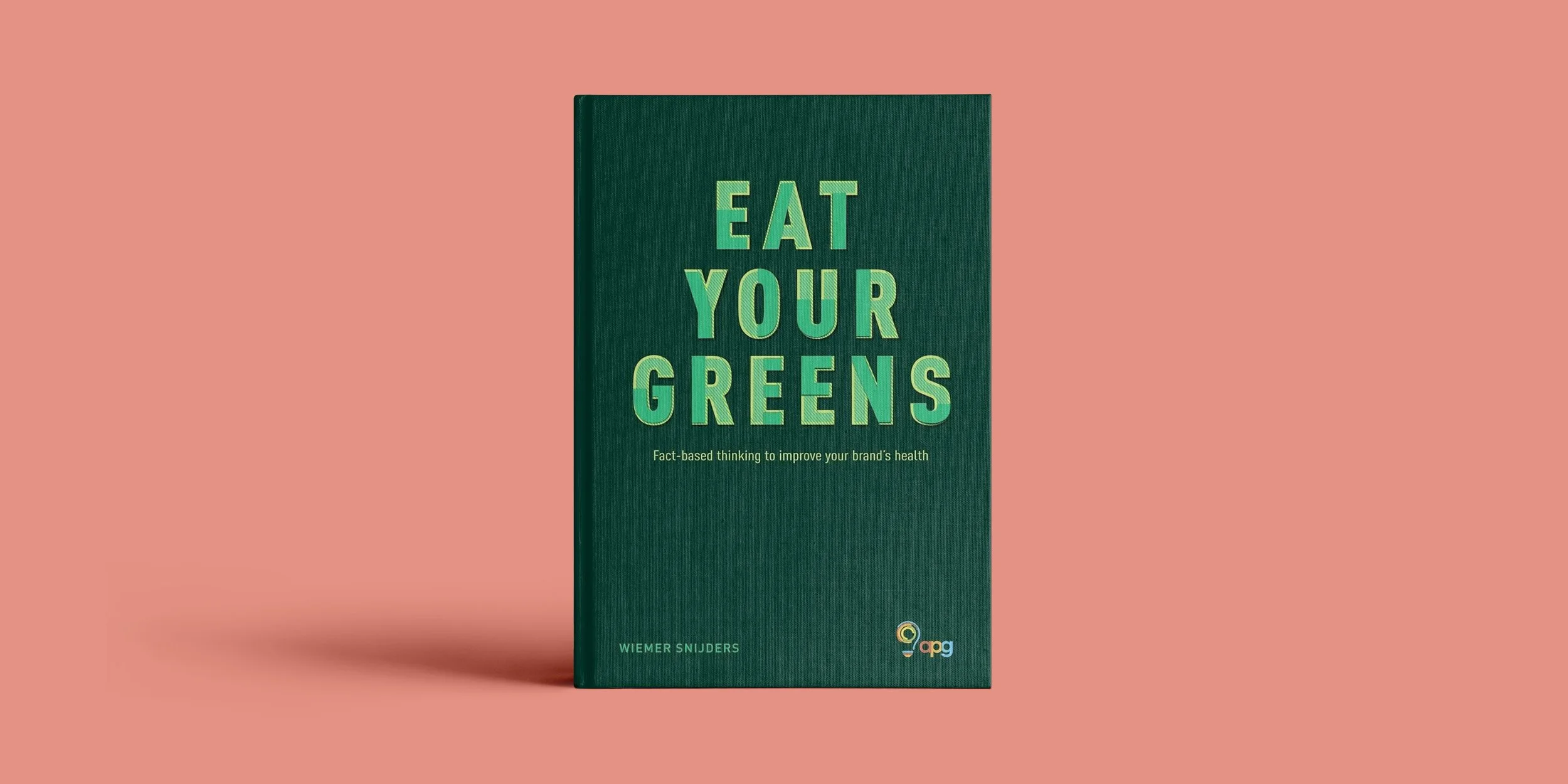
In the autumn of 2018 the Account Planning Group (APG) collaborated with Wiemer Snijders to publish Eat Your Greens.
The book is a collection of articles written by 35 experts in marketing and communications. In each chapter, a contributor describes how they apply a principle of marketing science.
Here’s a summary of five of my favourites.
Mark Ritson, What Ails Marketing?
Four dangerous trends that have a detrimental impact marketing: Mortification, tacticification, communification and digitisation.
Marketers repeatedly declare different ideas “dead”, but the disciple changes far more slowly than these dramatic predictions imply. The bigger issue is that marketers often skip the diagnosis of the situation and the building of a simple strategy, and jump straight to the selection of the tactics. Within the tactics, there is an obsession with the promotion P, despite product, place and price being equally important levers. And within promotion too much attention is placed on digital, when the split between digital and traditional channels is largely artificial. All channels are simply tactical tools, and should only be chosen once the target audience and positioning are clear.
Jerry Daykin, It’s Beyond Time to Rethink Social Media Marketing
Many of the metrics we measure in social media marketing are unfounded.
Take ‘engagement’. Nielsen found no correlation between the engagement/click-through rate of campaigns and the ROI they were able to drive. Or consider ‘fans’. Your followers do buy you more frequently. But there's a high reverse causality at play here as your heaviest buyers are far more likely to follow you in the first place. Finally let’s look at ‘organic reach’. A Coca-Cola executive once publicly shared that even $500 of media investment can get them in front of more people than an organic post shared with tens of millions of fans.
Becky McOwen-Banks, something is not adding up in Adland
Despite the fact that women account for 85% of all spending, they make up just 11% and 14% of creative directors in New York and London respectively.
It’s no wonder, then, that 70% of women say they are alienated by advertising, and a huge 91% say advertising doesn’t understand them.
Philip Graves, Everybody Lies
Philip Graves uses a useful ‘AFECT’ framework to evaluate the psychological validity of market research.
Analysis: Prioritise what people actually do over what they say they do.
Frame: Consider the consumer’s frame of mind at the moment of action.
Environment: Study behaviour in the context where it naturally happens.
Covert: Observe without making people overly aware they’re being researched.
Timeframe: Measure behaviour over time, not just in an instant.
Gareth Price, How Big Brands Stay Big
Big brands stay big by being simple, collective, and tight.
Let’s tackle these four ideas in reverse.
Big brands stay big by developing a tight positioning and portfolio that ensures a small set of associations are strengthened over time. These strong associations lead to the brand have a collective meaning. And this shared meaning makes choosing and buying the brand as simple as possible for the highest number of people as possible.
These are just five of the 35 lessons outlined in Eat Your Greens. The whole book is well worth a read.
Pick up your copy here.
Highly recommend.