Advertising’s master model
Introduction
In 2013, Les Binet and Peter Field changed the conversation around commercial creativity.
The pair published ‘The Long and Short of it’, which analysed 30 years of IPA Effectiveness Award entries; a dataset covering almost 1,000 different advertising campaigns, from more than 700 different brands in over 80 different categories.
The study aimed to answer a seemingly simple question. What were the strategies behind advertising’s most successful campaigns?
Over the course of 84 pages, a collection of profound principles were uncovered. Brands whose share of voice exceeds their share of market tend to grow. The number of business effects a campaign produces rises steadily as the campaign length increases. Campaigns that get talked about are the most effective of all, reducing price sensitivity and having a particularly powerful effect on profitability.
But beneath these bold headlines was a subtler and more systematic finding: There exists two different types of advertising.
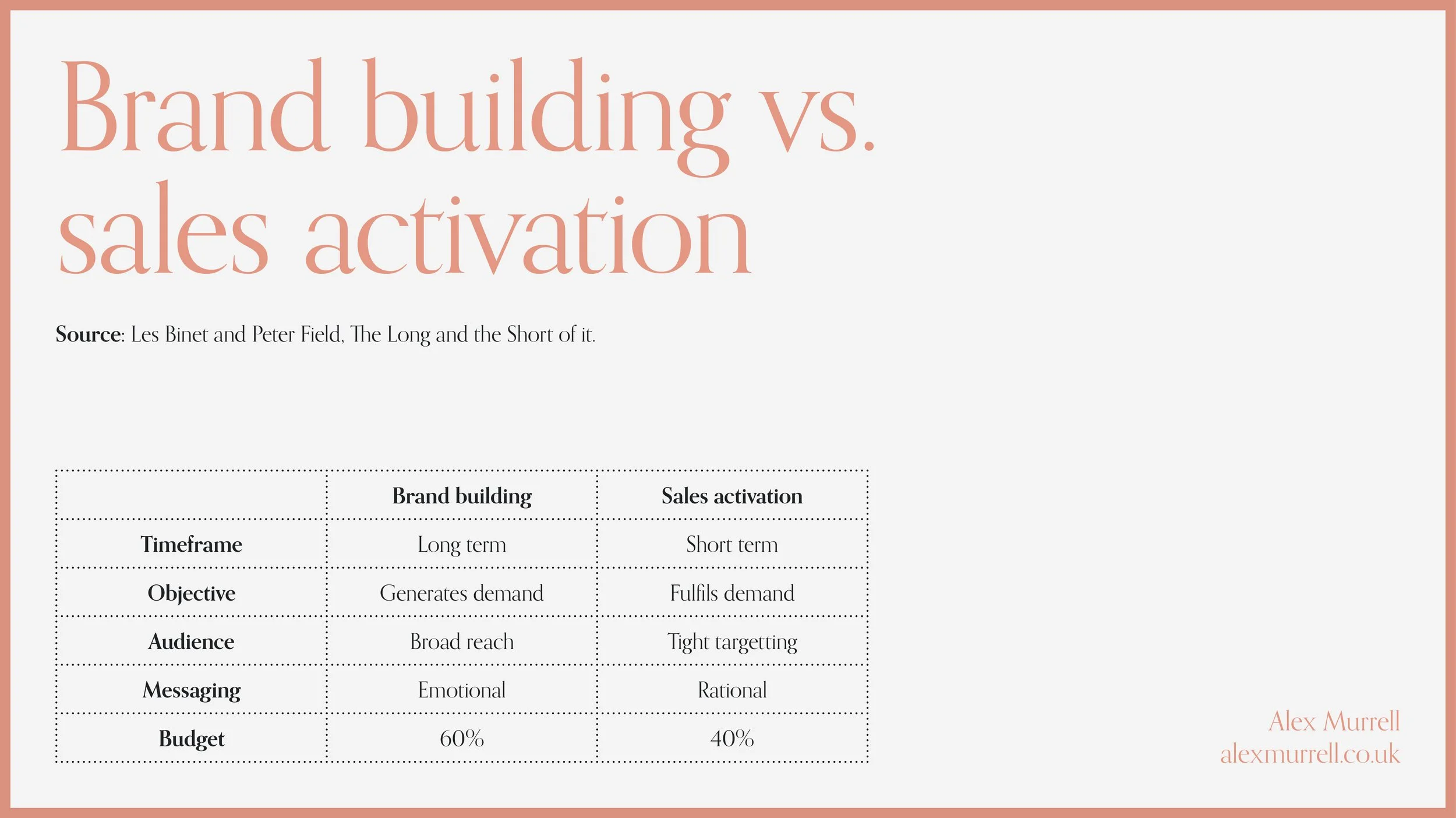
‘Brand building’ campaigns deliver long term improvements to a brand’s baseline sales. They optimise for effectiveness. They generate demand by reaching all consumers with emotional, brand messages. ‘Sales activation’, on the other hand, deliver short term sales spikes. They optimise for efficiency. They exploit demand by targeting existing consumers with rational product messages.
In a later report, ‘Media in Focus’, Binet and Field summed up this distinction. I’ll quote them at length:
“Brand building (…) requires broad-reach media, because the aim is to prime everyone in the market, regardless of whether or not they are shopping right now. And because most of the audience are not in the market at the time they are exposed, it cannot assume close attention. So it relies heavily on emotional priming, since that cuts through regardless of whether people are interested in the product (…). Sales activation is different. The aim here is to focus on people who are likely to buy in the very near future. That means exploiting existing brand equity to generate sales right now. Tight targeting is the order of the day, and rational persuasion has much more traction, because these people are more interested in what you have to say.”
To simplify, long-term brand building is broad reach and highly emotional. Short-term sales activations are tightly targeted and highly rational.
But the Godfathers of Effectiveness didn't stop there.
Binet and Field went on to analyse the optimal allocation of investment between these two types of advertising. Across the study's dataset, the pair found that slightly more should be spent on the long-term than the short. Back to Media in Focus:
“Balancing long-term brand building and short-term activation is crucial. Around 60% brand and 40% activation is still the best combination."
But this theory should not be thought of in isolation.
This article argues that Binet and Field’s framework overlaps with five other theories.
These theories are drawn from the advertising industry, of course, but also from the fields of marketing, psychology and neuroscience. They describe the types of advertising, but they also describe the types of target market, how people process the content that we create, and how our work impacts the attitudes and actions of the audiences we serve.
Let’s look at them one at a time.
Theory 01: Left brain vs right brain
In his book Lemon, System 1 Group’s Chief Innovation Officer Orlando Wood explores how the human brain is divided into two structurally different hemispheres:
“The brain is asymmetrical and it is divided. Its two hemispheres are very different. The right hemisphere is longer, wider and heavier than the left, and they differ in the number and size of neurones, and the number of connective branches put out by each nerve cell.”
But the differences are not only structural. The two hemispheres of the brain also attend to and process the world in different ways. It’s not that the hemispheres do different things, Wood says, it’s that they do things differently.
Here’s Wood summarising the differences succinctly:
“The left hemisphere abstracts things from their context and represents the world through mental models. It is goal oriented, seeking to manipulate and control the world through tools, through language and categorisation. It sees linear cause and effect, is self-conscious, literal, explicit and dogmatic, cutting off anything outside its model of the world.”
Wood continues:
“The right hemisphere experiences the world as it is, it sees the whole, understands the world through connections, relationships and embodied experience, sees depth and appreciates lived time, attends to novelty, deals with contradiction and therefore understands ambiguity, metaphor and humour. It is self-aware and has a sense of proportion and perspective.”
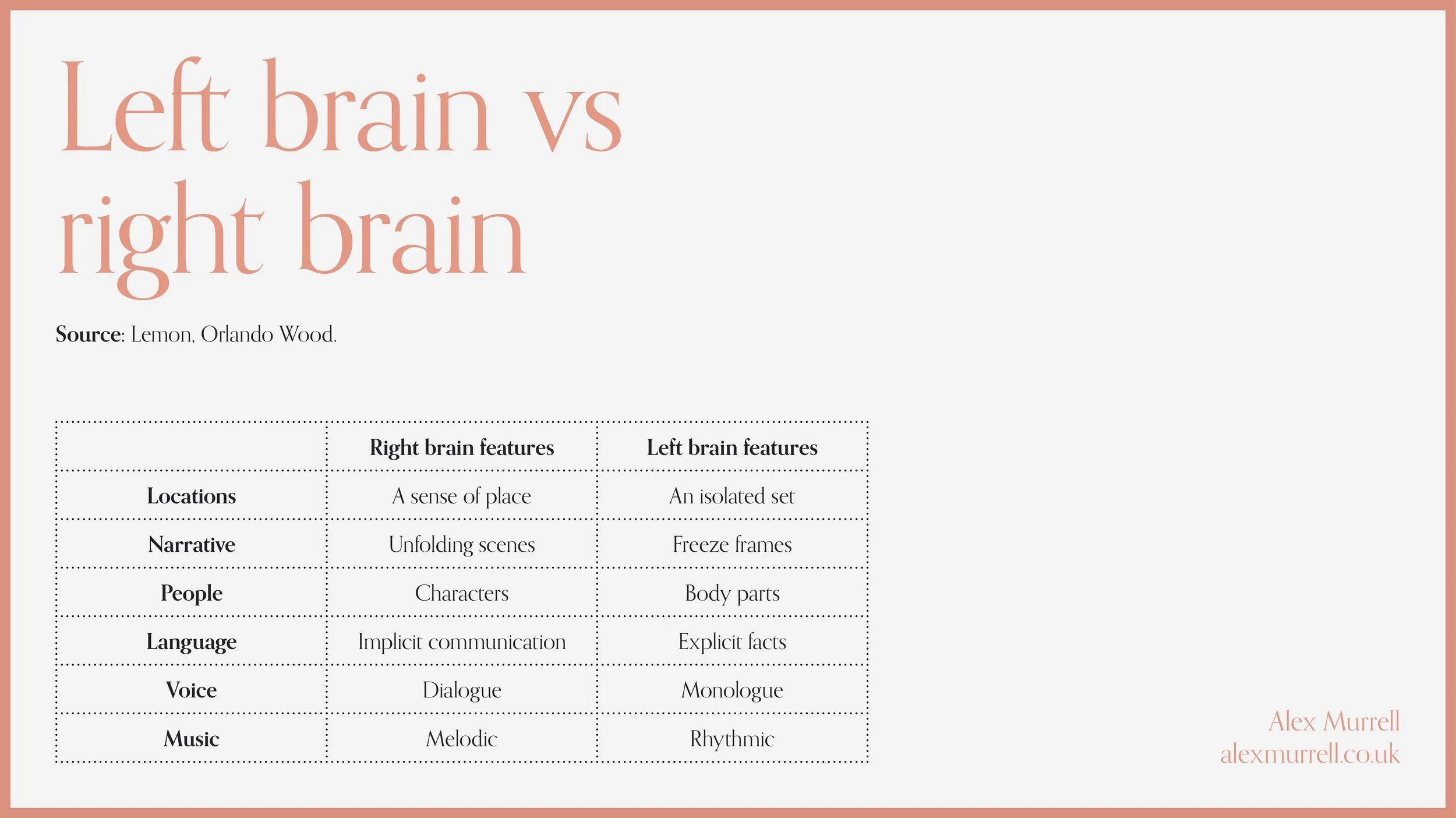
The left hemisphere works with a flat representation of the world around it. It draws on narrow attention, likes the literal and explicit and seeks to categorise information into existing, repeatable patterns and models. The right brain, on the other hand, works with the whole rather than the parts. It looks for connections and relationships, rather than facts. It likes the metaphorical and the implicit. And it seeks out the novel and new. In short, the left brain works with the map whilst the right brain works with the territory.
Wood goes on to demonstrate how different features of advertising ‘appeal’ to different hemispheres.
The left brain, for example, favours flatness, visuals of isolated features, written words, voiceovers, repetitive and rhythmic soundtracks. The right brain, on the other hand, favours whole scenes, characters, unspoken communication such as expressions, dialogue, a sense of place, humour and melodic music.
The use of these right-brained features, Wood finds, correlates strongly with high Star ratings on System 1’s ad testing database; a predictive measure of market share growth potential.
“System1 selected 100 UK and 100 US ads at random from System's 2018 Ad Ratings database to determine the relationship between the presence of these left- and right-brain features and advertising effectiveness, as determined by System's emotional Star rating score. (…) The results are clear and significant - the greater the number of left-brain features in the ad, the less likely it is to achieve a strong Star rating; the greater the number of right-brain features in the ad, the more likely it is to achieve a high Star rating (…). Left-brain features are harmful to long-term growth and right-brain features are helpful.”
It isn’t hard to imagine that the opposite is also true. That the literal, factual and explicit advertising features that appeal to the left-brain result in strong short-term effects. While the more emotional right-brain features do not.
In short, the brain’s right and left hemispheres perceive and process the world differently. Different features of brand communications appeal to these different hemispheres, and result in different brand outcomes.
Theory 02: Out-of-market vs in-market consumers
In 2021, John Dawes - a Professor of Marketing at The Ehrenberg-Bass Institute for Marketing Science - published a report in collaboration with The B2B Institute at LinkedIn.
The paper opened with a punchy provocation:
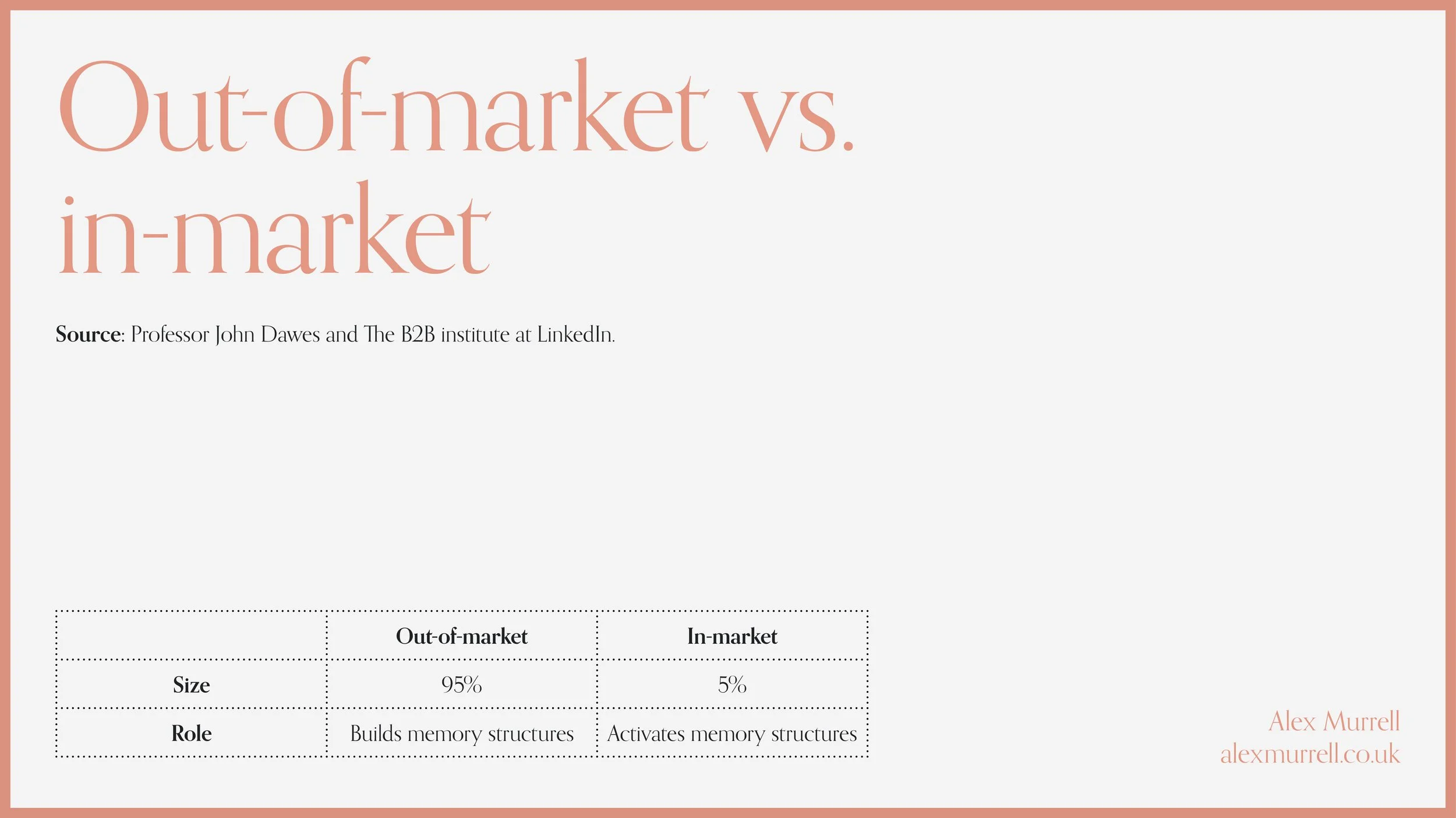
“It might surprise you to learn that up to 95% of business clients are not in the market for many goods and services at any one time.”
The idea that 95% of your customers are ‘out of market’ caught on, and quickly became known as the 95:5 rule.
But it was never meant to be an exact ratio. It was a rule-of-thumb rather than a precise prescription. Dawes goes on to explain the logic behind the counter-intuitive claim:
“Has your business recently made a significant purchase, like a new phone system, engaged with a new payroll software vendor, signed a contract with a salesforce IT support company - or perhaps even bought new carpet for the office? If you have, then you’ll know that you’re not in the market for those items now, nor will you be for quite a while. The time between purchases for many goods and services is quite long. Corporations change service providers such as their principal bank or law firm around once every five years on average. That means only 20% of business buyers are ‘in the market’ over the course of an entire year; something like 5% in a quarter – or put another way, 95% aren’t in the market.”
In a category that is bought once every five years, 95% of customers are ‘out-of-market’ in any one quarter.
Further data from Ehrenberg-Bass shows that most companies buy computers once every 4 years. By applying the same formulas, we can calculate that 93.75% of buyers are ‘out-of-market’ in the computing category.
And it isn't just B2B. According to the same study, the majority of consumers buy new cars every 10 years. This means that, in any given quarter, 97.5% of consumers are not currently in market.
I’m sure many FMCG categories will have much higher ‘in-market’ percentages. But, again, the 95:5 rule was never intended to be a taken literally. It is simply an illustration for a much broader principle: most of the time, most category buyers are not ‘in-market.’
This deceptively simple fact has radical ramifications for advertising.
Back to Dawes’ paper:
“The way advertising ‘works’ isn’t by stimulating us to buy. How can it, if most people who see an ad aren’t going to buy the product for perhaps a year or more. Therefore, the way it works must principally be by building a memory link for the brand in buyers’ minds. And this memory link will be activated when the buyer does come into the market.”
If the majority of customers are not currently in-market, then the majority of a brand’s advertising should not be seeking to sell in the short term. It should be building relevant associations that predispose that majority to buy your brand when they eventually enter the market.
But if advertising’s biggest audience is those who are not actively pondering a purchase, aren’t they also the least likely to pay attention to our ads?
This leads us neatly on to our third theory.
Theory 03: Passive attention vs active attention
In my article 'Thinking Rationally About Emotion' I discussed how humans evolved to have two modes of attention.
Imagine, for example, our oldest ancestors. When searching for food, a slow and deliberate mode called ‘active attention’ would be used. But when surveying for threats, a fast and automatic mode, known as ‘passive attention’, would be applied. Active attention focuses on finding food whilst our passive attention keeps watch over everything else.
Here’s Robert Heath in his must-read book, Seducing the Subconscious:
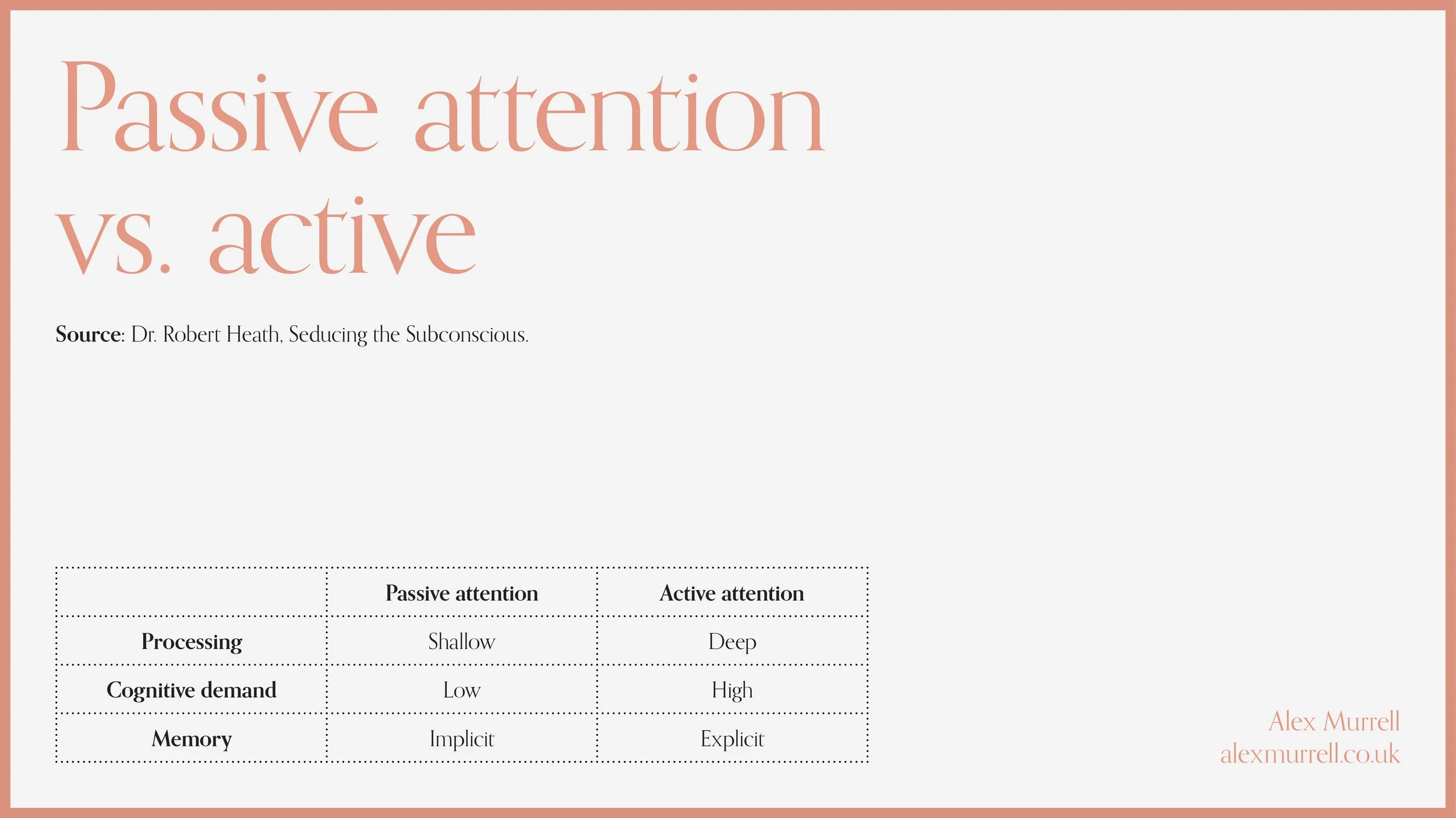
"Active attention is when the level of attention is high and the application is wilful, deliberate, and controlled by the individual (…). The opposite of active attention is passive attention. This is when the level of attention is low, and the application is inadvertent and not under the control of the individual."
These two modes operate in tandem. One broad, involuntary and stimulus-oriented, scanning the environment for anything that might matter. The other is narrow, intentional and goal-oriented, deployed when we decide something deserves focus.
Crucially, however, the distinction isn’t just about how much attention we pay, but about what happens once that attention is engaged.
This is where Heath takes the argument a step further. He links each type of attention to the neurological mode with which we process information:
"Deep processing occurs when maximum active attention is being applied and maximum cognitive resource is being deployed. Shallow processing, on the other hand, refers to situations where limited cognitive resource is applied."
Active attention leads to deep processing, which uses lots of cognitive resources not just to record information but to understand, categorise, and relate it to other ideas that we have learned in the past. Passive attention, on the other hand, leads to shallow processing which uses few cognitive resources and is primarily concerned with registering and encoding information by allowing impressions, feelings and associations to form without deliberate effort, analysis or awareness.
Now, a common assumption might be that when we pay active attention and process information deeply, this information would register it more strongly in the memory. But this is not the case. In fact, counter-intuitively, the exact opposite appears to be true.
Heath's research finds that brand associations which receive active attention and are deeply processed and stored in our short-term, limited and conscious ‘explicit memory’. Whilst those that are acquired or absorbed through passive attention, are shallowly processed and stored in our long-term, vast and automatic ‘implicit memory’.
Back to Heath:
"My theory is that the most successful advertising campaigns in the world are not those we love or those we hate, or those with messages that are new or interesting. They are those (…) that are able to effortlessly slip things under our radar and influence our behaviour without us ever really knowing that they have done so. And the way in which these apparently inoffensive ad campaigns work is by ‘seducing our subconscious’.”
Heath's theory of low attention processing in advertising pulls together insights on attention, processing and memory. And it also shares many similarities with our fourth theory. The Nobel Prize winning work of Daniel Kahneman.
Theory 04: System 1 vs System 2
In 1968, Amos Tversky and Daniel Kahneman were rising stars in the psychology department at the Hebrew University of Jerusalem. But beyond this, the two had very little in common.
Tversky was an optimist with a sharp mind and a confident swagger. He disliked metaphor and ambiguity, preferring the certainty of mathematical models to explain behaviour. He was organised and disciplined, working from a spotless office. Kahneman, on the other hand, was prone to pessimism and was a constant worrier. He worked from a disorderly office, revelled in ambiguity and liked to question everything, including his own thinking and theories.
But perhaps their biggest difference was found in how they believed people made decisions. Tversky’s model of ‘mathematical psychology’ saw people as largely rational; weighing risks and rewards before making optimal decisions. But Kahneman came from the ‘perceptual psychology’ school of thought. He focussed less on the how people should think, and more about how they actually do. One believed in clean models that removed noise, inconsistencies, and errors. They other believed these to be the key to understanding human judgement.
When these two minds came together, it led to a period of extraordinary productivity and creativity that would eventually win Kahneman the Nobel Prize in Economics.
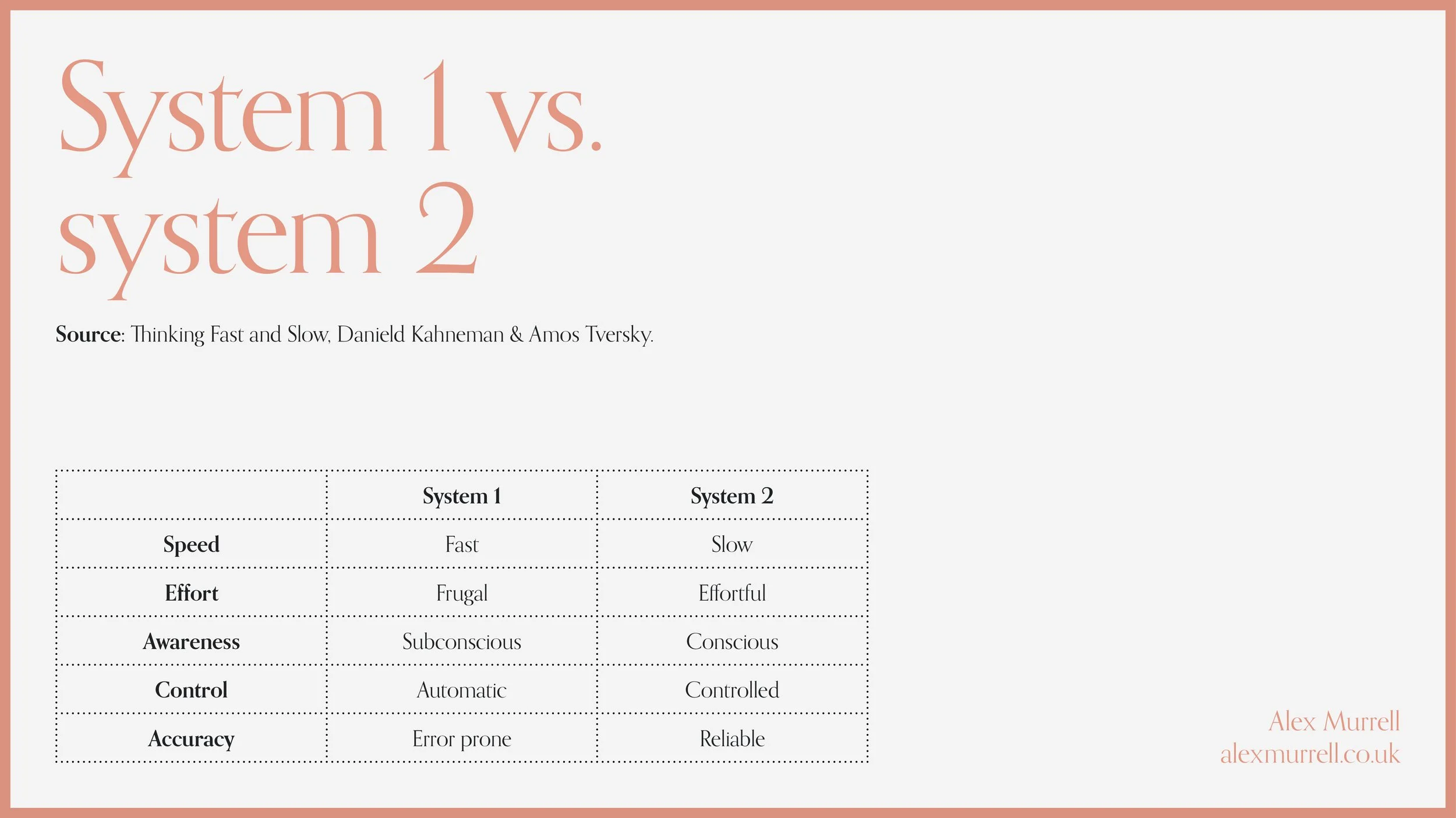
Their work culminated in the concept that human cognition has two modes. ‘System 1’ is fast, frugal, subconscious, automatic and error prone. ‘System 2’, on the other hand, is slow, effortful, conscious, controlled and reliable.
Here’s Kahneman in his iconic book ‘Thinking Fast and Slow’:
“System 1 operates automatically and quickly, with little or no effort and no sense of voluntary control. System 2 allocates attention to the effortful mental activities that demand it, including complex computations. The operations of System 2 are often associated with the subjective experience of agency, choice, and concentration.”
You drive a familiar route for miles without consciously considering how to operate the car, or how to navigate the route. That’s your system 1 in action. But suddenly you arrive at a crossroads where the traffic lights are not working. Your logical, analytical system 2 takes over, enabling you to navigate the new and uncertain situation safely.
Kahneman explains that whilst we consider ourselves conscious, logical thinkers, the majority of our thought is anything but:
“When we think of ourselves, we identify with System 2, the conscious, reasoning self that has beliefs, makes choices, and decides what to think about and what to do. Although System 2 believes itself to be where the action is, the automatic System 1 is the hero.”
Kahneman makes it clear that system 1 and system 2 are modes of thought, not physical structures. As the psychologist says, “There is no part of the brain that either of the systems would call home.”
This brings us to our final theory, which covers not just how people process advertising. But how they respond to it.
Theory 05: Direct vs indirect responses to advertising
Stephen King (not that one) was born on 25 February 1931, studied philosophy and ancient history at Oxford and in 1957 joined the advertising agency J Walter Thompson in London. Whilst at the company, King set up and ran the Advertising Research Unit, the New Product Development Unit and, one of advertising’s first Account Planning departments.
On his retirement in 1988, JWT published ‘The King Papers’ a collection of papers published between 1967 and 1985, that were later curated into the book ‘A Masterclass in Brand Planning’. In one of these papers, ‘Practical Progress from a Theory of Advertisements’ King introduces a model which describes a ‘scale of immediacy’ in how people respond to advertising.
It was King’s strong belief that different advertising campaigns worked in markedly different ways. So he concentrated his attention not on advertising generally but on the various ways in which people responded to it.
Here’s Jeremy Bullmore, another advertising great, describing King’s framework:
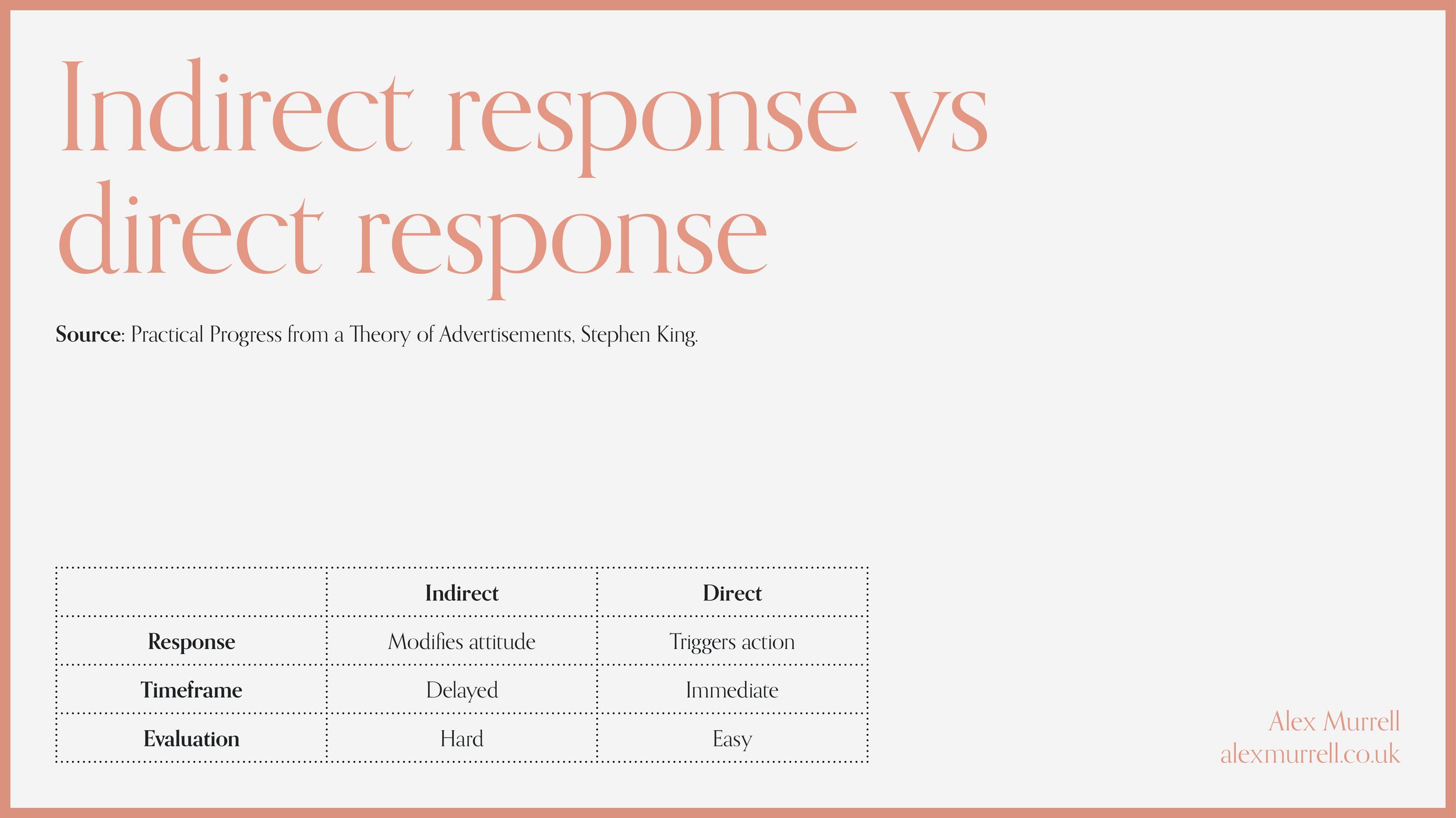
“At the very top of this scale, the clear purpose of any advertisement is to achieve immediate action. It’s long been called direct response. It sets out to get people to pick up a phone, to write out a cheque, to click on ‘confirm’: it’s about as immediate as it gets. No intervening stage or process is required: ad leads directly to action. Transparently easy to understand and marvellously easy to evaluate, this most immediate function of advertising is seldom contentious. But as the Scale of Immediacy progresses, the expectation of immediate action becomes more and more remote: from ‘Seek information’, through ‘Modify Attitudes’ until we reach the least immediate of them all which King calls ‘Reinforce Attitudes.’ And it’s this last role for advertising that has always generated more than its fair share of academic squabbling, social unease, creative posturing and financial directors’ bewilderment.”
At one end of the scale, advertising prompts a direct response from consumers. A person sees an ad, then they act. At the other end, advertising causes an indirect response. A person sees an ad, and their perceptions of the brand are modified.
King explains that, whilst the latter end of the scale is one of the primary functions of advertising, its delayed impact on consumer action causes it to be hard to measure:
“This is one of the most common and fundamental roles for advertising; yet because it is mainly defensive and is dealing with the stability and intensity of attitude, it is always going to be very hard to measure.”
But whilst its impact is hard to measure, its effect is undeniable. When large portions of the population have their attitudes modified or reinforced, perception gradually becomes predisposition, which gradually becomes preference, and eventually purchase.
King’s paper demonstrates that there is not one type of advertising. Or, more specifically, there is not one type of response to advertising. There is advertising that triggers an immediate action. And there is advertising that modified attitudes.
But how do these five theories work together?
Conclusion
Let’s try and bring together everything we’ve explored so far.
Binet and Field distinguish long-term, emotional, brand building from short-term, rational, sales activations. Wood shows that the right-brain processes the whole, while the left-brain processes the parts. Dawes separates the many out-of-market consumers from the few who are actively in-market. Heath found stimuli received through passive attention are stored in the implicit, long-term memory, while stimuli received through active attention is stored in the explicit, short-term memory. Kahneman and Tversky showed that people have a fast and frugal, System 1 mode of thought and a slow and effortful System 2. And King argues that some advertising works by triggering an immediate response and some by shaping attitudes over time.
But perhaps these different theories are not as separate as we might have first thought. Perhaps they all overlap. Perhaps they all point to one, bigger, broader, more well-rounded picture of how brands get built.
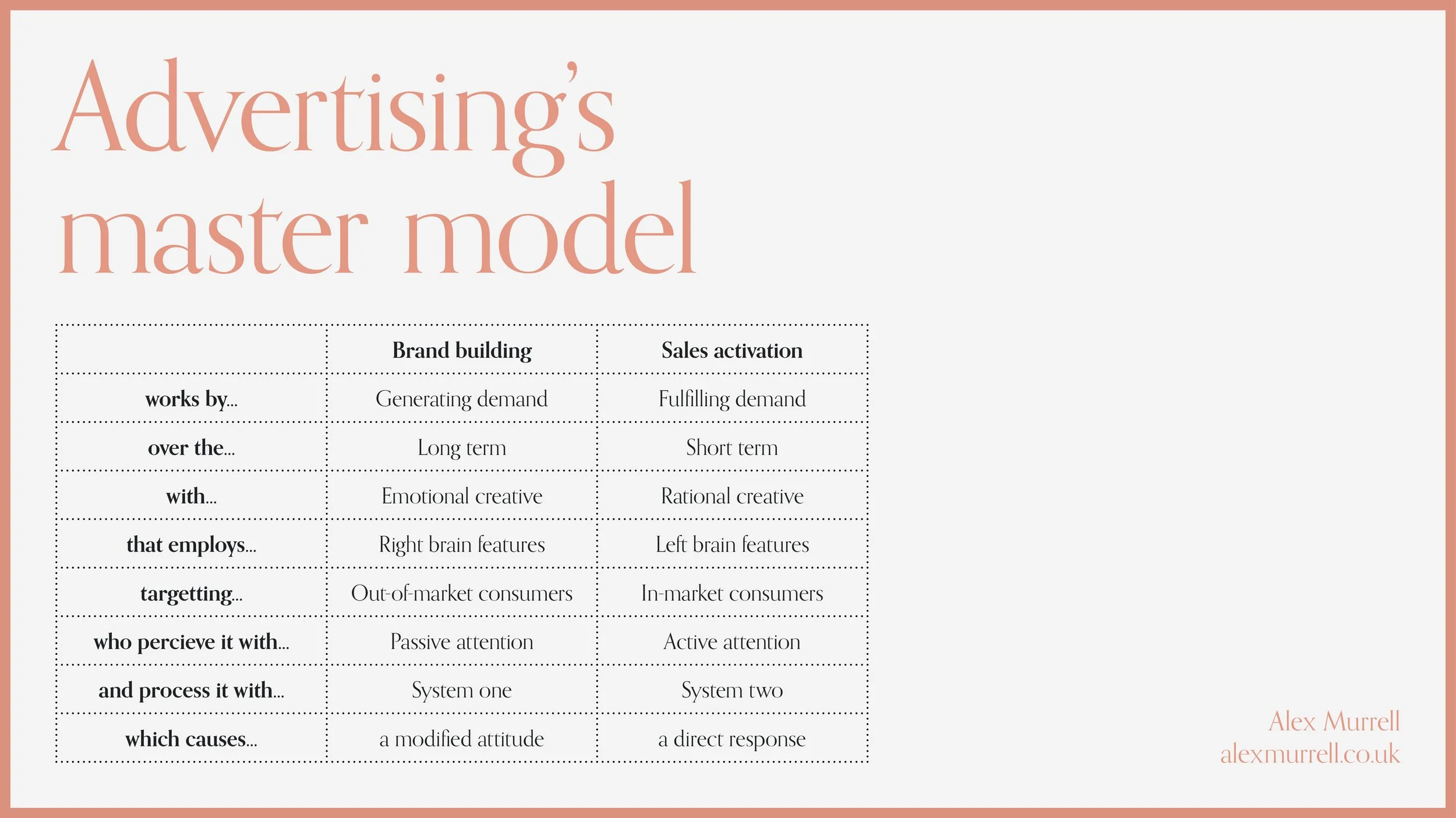
Here’s my best attempt at drawing a red thread through all of our theories.
Emotional brand building campaigns, generate demand by employing right-brain features, reaching those who are out-of-market, are passively attended to, processed by System 1, and have the indirect effect of shaping attitudes over time. Rational sales activations, on the other hand, fulfil demand by employing left-brain features, targeting those who are in-market, are actively attended to, processed by System 2, and have the direct effect of triggering an action.
By bringing these six impactful ideas together, we can create a more complete, more cohesive, understanding of how brand communications work.
This ‘master model’ describes two fundamentally different types of advertising. But it also describes who that advertising reaches, how people perceive, process and remember it, and how it impacts their attitudes and actions.
Since the 1960s, different practitioners from different fields have provided us with different parts of the puzzle. But it's time we stopped speaking about them separately. It’s time we stopped thinking about them as individual ideas. It’s time we stopped focussing on the pieces and started focussing on the picture.
Because it's becoming clear that decades of disparate research now point in one direction. Different types of communication do different jobs, in different ways, for different audiences. The brands that win will be those that master the ‘master model’. They will build their brands over the long term, with emotional creative that moves the passive masses. And they will drive sales in the short term, with rational creative that motivates the tightly targeted active audience. It’s not one or the other. It’s not either, or. The answer is almost always both.
This is the master model.
As that really is, the long and the short of it.