Orlando Wood, Lemon
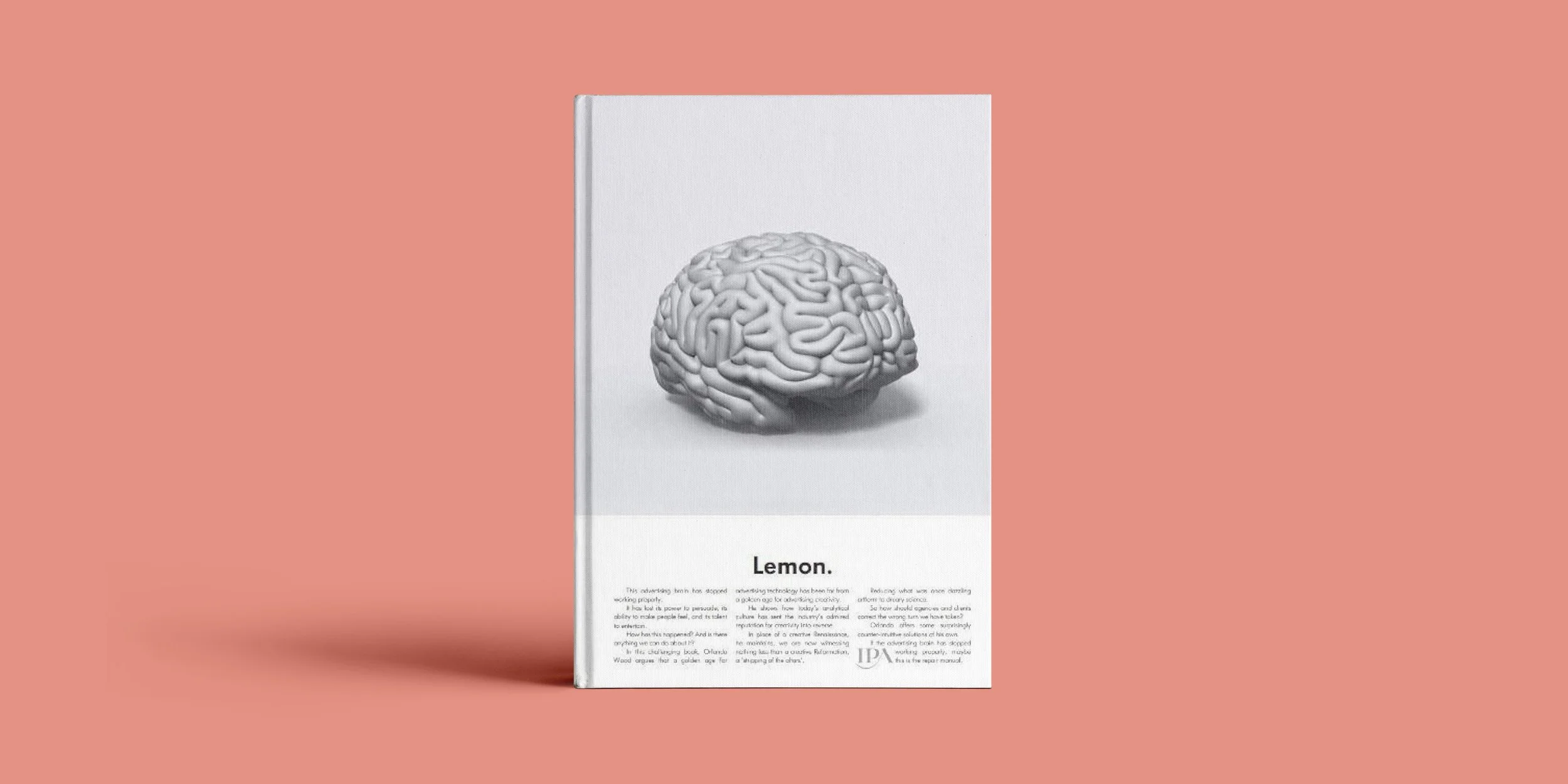
Published in 2019, Orlando Wood’s book ‘Lemon’ uses a unique mix of neuroscience, art history and advertising effectiveness research to shows how an increase in abstract, left-brain thinking has spread across business and popular culture, undermined creativity and made advertising less effective.
I’ve summarised the book below for those who haven’t read it.
The brain’s hemispheres are physically different
The right hemisphere is longer, wider and heavier than the left. The hemispheres differ in the number and size of neurones, and the number of connective branches put out by each nerve cell. The only bridge between them is the corpus callosum: a bundle of fibres that connects similar regions in each hemisphere. Information transfer across this bridge is slower from left to right than from right to left, and the suppressive effect of the left hemisphere on the right is greater than that of the right on the left.
The brain’s hemispheres attend to the world differently
The left brain has a narrower and more goal-oriented focus. It breaks things up into parts, categorises them, and favours the familiar, consistent, repeatable and predictable. It sees things in terms of simple, linear cause and effect. It prizes utility, power and control. Its principal tools are language, symbols and signs. It favours clarity and certainty, and it is literal and explicit. It cannot deal with contradiction or ambiguity, seeing things as either categorical lies or truths. Its model of the world is flat and simplified, lacking in depth or nuance. It lives firmly in the present or its planned future. It has little gift for music or appreciation for beauty.
The right brain has a broad attention. It sees the whole rather than the parts. It understands the world through the relationships and connections between things. It is rooted in bodily or visceral experience, and has an understanding of the living. It is empathetic, and is attuned to unspoken communication such as gesture and expression. It attends to what's novel and has the flexibility to cope with contradiction, metaphor, humour and irony. It understands the passing of time and has a sense of events unfolding. If language principally resides in the left hemisphere, music is the natural language of the right. The right brain is self-aware. It has sense of morality, duty, responsibility, and therefore guilt.
Creatively we oscillate between whole and left brained periods
Periods of whole-brained creativity are characterised by collaboration, community, a very broad and heightened sense of one's time and place in the world, a sense of responsibility for one's own actions, a fascination for difference, and a greater sense of empathy. These periods are questioning and seek possibility. There is a depth and humanity to culture, a referencing of other things, a sense of flow; the living and betweenness are prioritised.
Periods of left-brained creativity are characterised by a desire for power and control, by hierarchy, rules, repetition, centralisation, standardisation, categorisation and specialisation. Society becomes rigid and brittle. Things are interpreted literally and there is a dislocation from places, people and the past. There is a lack of empathy and a sense of intolerance, paranoia, anger and self-consciousness. There is a loss of uniqueness, a sense of repetition and homogeneity. Culture becomes flatter, more abstract and conceptual. Words and symbols take on a new importance.
Different features of advertising ‘appeal’ to the different hemispheres
The left brain favours flatness, visuals of isolated features, written words, voiceovers, repetitive and rhythmic soundtracks. The right brain, on the other hand, favours whole scenes, characters, unspoken communication such as expressions, dialogue, a sense of place, humour and melodic music.
Ads employing right-brained features are more effective
System1 selected 100 UK and 100 US ads at random from the company’s Ad Ratings database to determine the relationship between the presence of these left- and right-brain features and advertising effectiveness.
The results are clear. The greater the number of left-brain features in the ad, the less likely it is to achieve a strong Star rating (a predictor of market-share growth potential). The greater the number of right-brain features in the ad, the more likely it is to achieve a high Star rating. Left-brain features are harmful to long-term growth and right-brain features are helpful.
Advertising creative is has become dominated by left-brained features
A marked change in advertising style has occurred in the first decade of the 21st century. Hemispheric balance has been lost. Left-brain features now dominate, where right-brain features once had the upper hand. These changes can be characterised as an increase in abstraction and flatness, a reliance on rhythm, and an emphasis on unilateral messaging, including the written word on-screen features that appeal to the left brain. In the same period, advertising has been devitalised and dehumanised; we've lost dialogue, drama, implicit and knowing glances, gestures and accents. Advertising has become literal and self-conscious. It has lost its sense of betweenness, a right-brained appreciation of the living and lived experience. We've also lost a clear sense of time and place, music, wordplay and references to other cultural works.
The book provides much more depth and detail than this summary could ever capture.
Pick up your copy here.
Highly recommended.