Alan Cooper, How To Plan Advertising
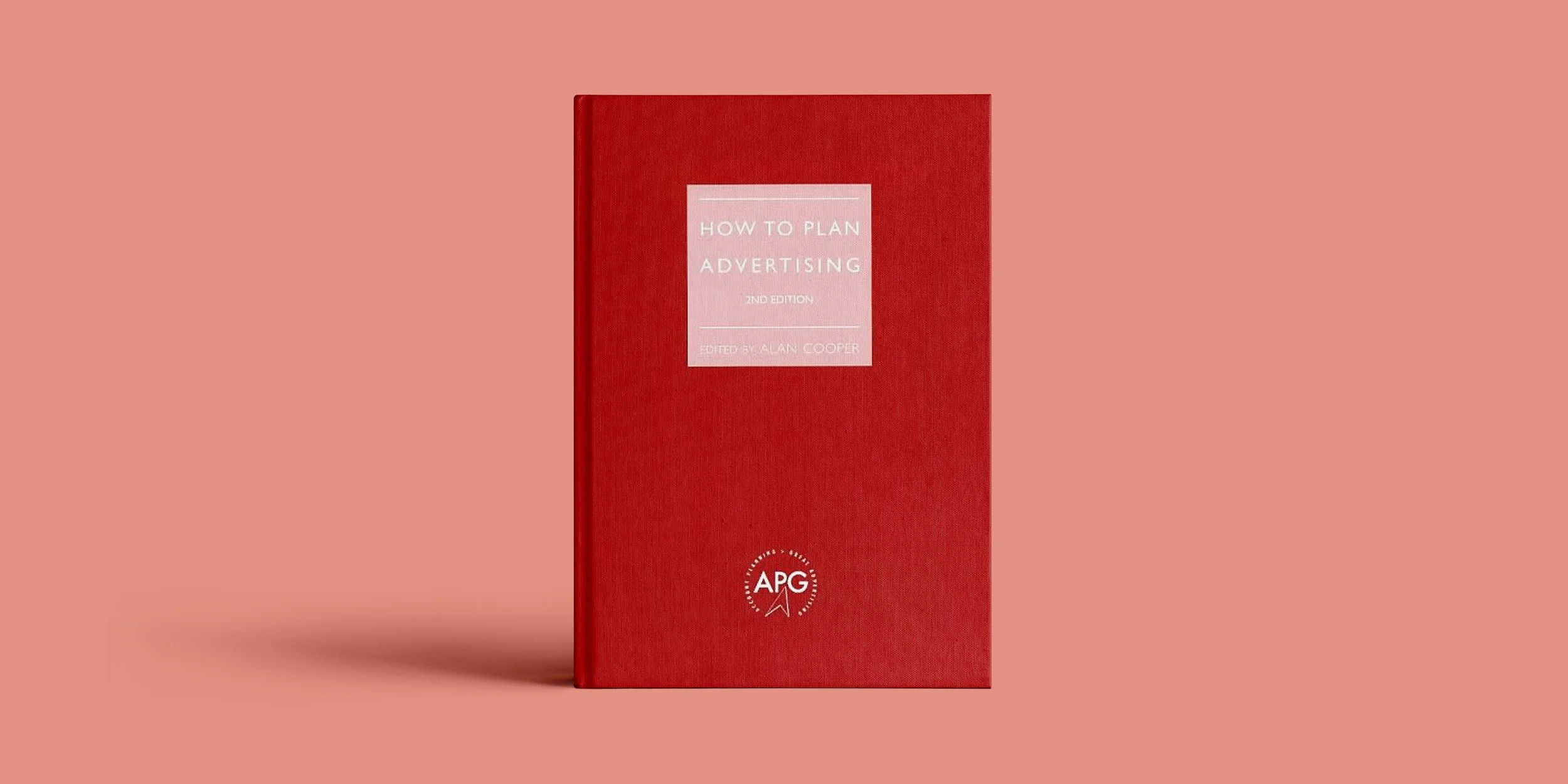
‘How to Plan Advertising’ is one of the foundational texts of account planning.
Originally published in 1997 by the APG, and edited by Alan Cooper, the book brings together eleven essays from some of the discipline’s leading practitioners.
Together the collection of papers explore how strategy, research and creativity can combine to produce more effective advertising.
Here’s five of my favourite lessons from the book.
Align on how you think the ad will work
‘Classic' theories of how advertising works are mainly of the single-model kind. They make the case that advertising works is a particular way. These single-model theories include AIDA (which states that Awareness is leads to Interest which leads to Desire which leads to Action), and the Unique Selling Proposition or USP (which depends on finding a motivating point-of-difference within the products).
However, since the 1930s, it has been acknowledged that advertising works in more than one way. The most enduring of these multi-model frameworks is James Webb Young's 'Five Ways' (1963). Young states that advertising works in one of five ways:
By familiarising
By reminding
By spreading news
By overcoming inertias
By adding a value not in the product
Since Young, many other multi-model frameworks have been proposed (see Paul Feldwick’s 5S framework from his book The Anatomy of Humbug).
So before you begin developing the advertising idea, it’s important to align on how you believe the advertising will work.
Don’t confuse the current audience with the target audience
One classic marketing ‘pitfall' is to confuse a definition of the target audience with a statement of the current customer profile. Available data sources almost certainly yield the latter, but, unless the objective is solely repeat purchase, it is likely that the former will differ from this.
First, clearly define your current consumer. Then paint a picture of a different, or broader, audience that you wish to recruit.
Separate the objectives from the strategy
The difference between objectives and strategy can be defined as being:
An objective is the goal, or end result, that one is seeking to achieve.
A strategy is the means by which you intend to achieve that goal.
Given this distinction, it follows that one ought to be able to state an objective in the absolute, to preface it with the word "To”. A strategy therefore becomes the conditional element, prefaced by the word “By”.
Hence a typical objective might be: "To increase market share…” and the strategy might be, “…by improving product quality on the dimensions of taste and colour”. Similarly a typical advertising objective might be: "To demonstrate the versatility…” and the strategy, “…by giving examples of both in-home and out-of-home usage”.
So, an objective is what you want to achieve, and a strategy is how you intend to achieve it.
Don’t confuse creative development research and pre-testing
Define creative development research can be defined as researching the consumer response to an advertising idea prior to production, and pre-testing as researching a finished advert prior to media placement. The former is typically qualitative, and the latter usually quantitiative.
These are different types of research, that require different approaches, and are used at different parts of the process. Do not conflate or confuse them.
Control for the ‘brand size effect’
Brand size can have an effect on brand image. For example, imagine asking a sample of consumers which cereal brands taste nice? Cornflakes scores 64% and All Bran scores 10%.
It would be easy, looking at this, to conclude that Cornflakes is the stronger brand than All Bran on "Tastes nice", and that a clear goal for advertising would be to persuade people that All Bran tastes as good as Cornflakes.
But what in fact happens is that bigger brands in a category tend to get rated more highly or on more attributes by more people. As such, Cornflakes also scores significantly better on ‘easy to digest’ (60%) than All Bran (19%).
So rather than looking at these brand image scores as absolute figures, it is wise to control for brand size and analyse which attributes a brand scores higher or lower than the brand’s size would predict.
This list of five lessons only scratches the surface. ‘How to Plan Advertising’ is full of timeless truths and insightful opinions.
Pick up your copy here.
Highly recommended.